The Wrong Engine
Wall Street measures the economy in earnings beats. But GDP runs on paychecks - and in June alone, the US Economy lost 514,000 full-time jobs while 720,000 people stopped looking for one.

Over the past decade, seven companies created roughly $20 trillion in shareholder wealth - the greatest concentration of profit and market value in financial history. In June 2026, the US economy lost 514,000 full-time jobs, and another 720,000 Americans gave up looking for work entirely. The unemployment rate fell - and that is the most dangerous part of the story.
Wall Street believes the earnings tape makes the labor data irrelevant. This article is about why it is precisely the other way around.
The Identity Nobody Argues With
Every debate about the US economy eventually has to pass through one equation: GDP = C + I + G + NX. Consumption is roughly two thirds of American output. Households consume out of income, and household income is overwhelmingly wages and salaries. The chain of causation is short and unbroken: jobs produce paychecks, paychecks produce consumption, and consumption produces growth.
Corporate profits sit nowhere in that chain. A profit is a residual - what remains after the economy has already generated the demand that produced the revenue. Profits are a claim on growth that has already happened, not a cause of growth to come. This distinction sounds academic until you put the three series on one chart. Then it becomes the whole story.
Three Lines, One Story
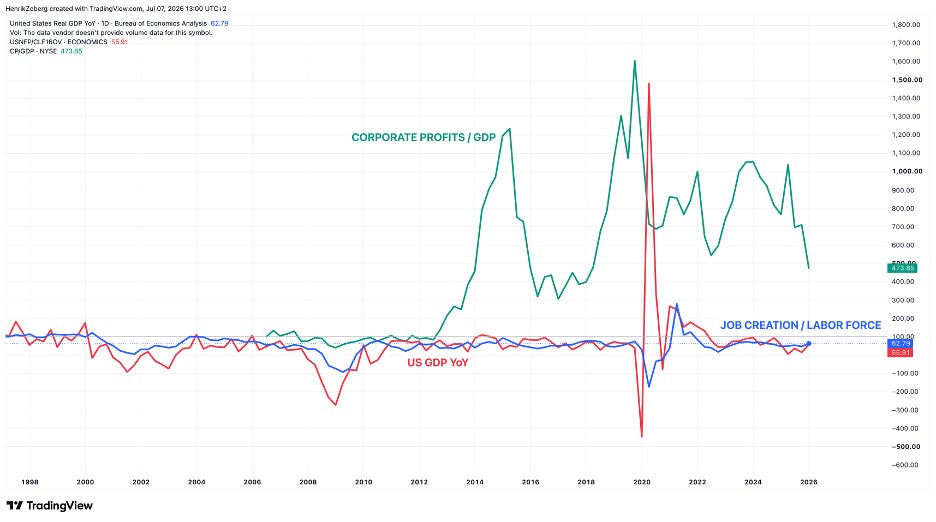
US real GDP YoY (red), job creation relative to the labor force (blue), and corporate profits relative to GDP (green), 1998 - 2026. Sources: BEA, BLS, TradingView.
Two of these lines are the same line. GDP growth and job creation move together through every cycle on the chart - the 2001 recession, the 2008 collapse, the 2020 shock, and the current softening. They are structurally coupled, because they are two measurements of the same underlying process: labor income becoming demand.
The third line lives a different life. From roughly 2012 onward, corporate profits relative to GDP decoupled completely - exploding to levels with no precedent in the prior half century while GDP growth and job creation stayed locked inside the same range they have occupied for sixty years. If profits drove growth, the decade after 2012 should have produced the strongest labor market and the fastest expansion in modern American history. It did not. Job creation never left its historical band.
And note where the green line is now: rolling over hard from its highs - while the two lines that actually measure the economy sit near stall speed. The market celebrates the level of the green line. The economy runs on the other two.
Profits Do Not Hire
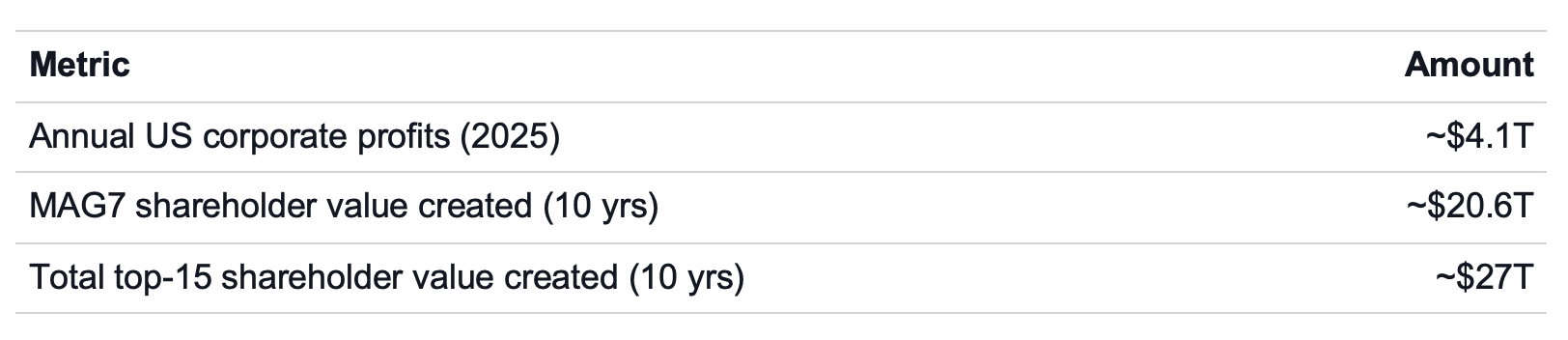
The scale of the disconnect deserves numbers. US corporate profits ran at roughly $4.1 trillion in 2025 - an annual income figure. Over the past decade, the Magnificent Seven alone created roughly $20.6 trillion in shareholder wealth - a valuation figure, and by Morningstar’s estimate about 76% of everything generated by the decade’s fifteen biggest wealth creators combined.
Now set that against employment. The Magnificent Seven employ roughly 2.4 million people - about 1.5% of total US employment, and the majority of that headcount is Amazon warehouses. Over the decade in which they created $20.6 trillion in wealth, the seven added fewer than 2 million jobs combined. That is on the order of $10 - 11 million in shareholder wealth per job created. Strip out Amazon, and the remaining six created wealth at a rate of over $30 million per job.
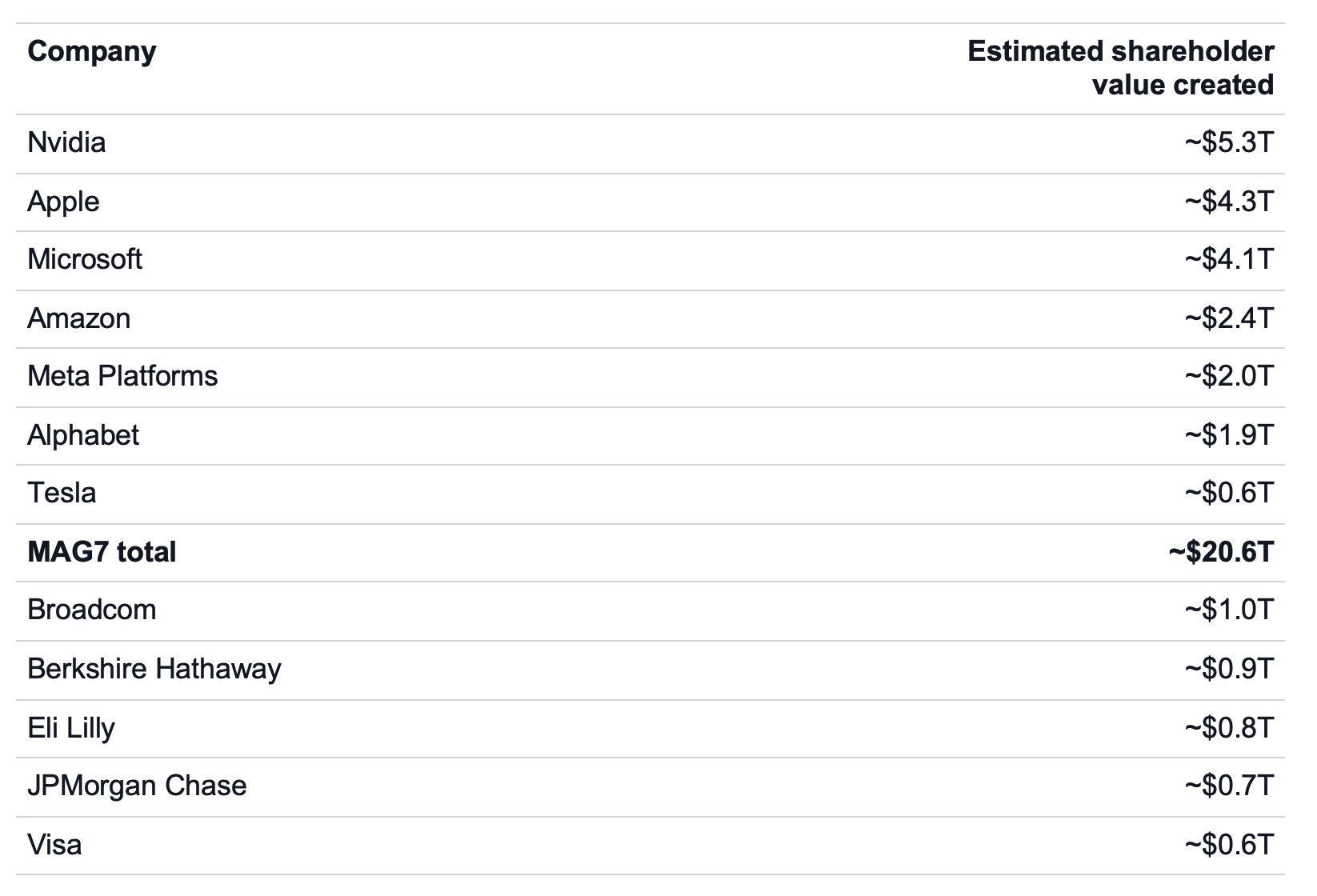
Estimated shareholder value created over the past ~10 years. Morningstar estimates the 15 biggest wealth creators generated roughly $27 trillion, with the Magnificent Seven accounting for about $20.6 trillion (~76%). Figures rounded.
The wealth is real. The employment is not. Nvidia - the single largest wealth creator of the decade at roughly $5.3 trillion - employs 42,000 people. Kroger employs ten times as many. This is not a criticism of Nvidia; it is the business model. The most profitable companies in history are profitable precisely because they produce enormous revenue with almost no labor. Which means their profits, however spectacular, put almost no paychecks into the economy - and paychecks are what the GDP identity runs on.
The Wealth Engine vs The Jobs Engine
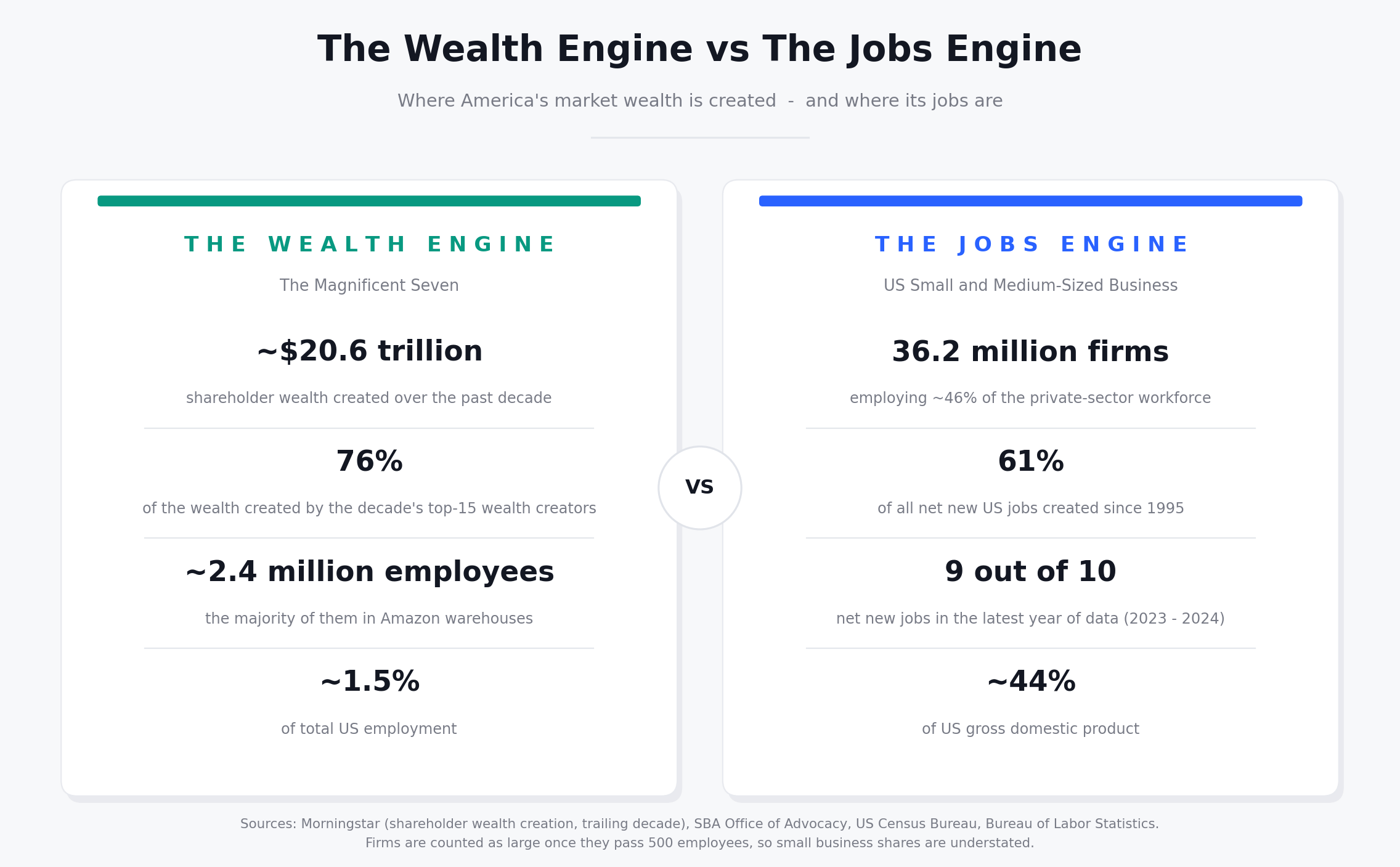
Two engines, two functions. The one the market watches creates wealth. The one the economy runs on creates jobs.
So if the profit giants do not create the jobs - who does? The answer is documented every year by the SBA’s Office of Advocacy, and it is unambiguous. The United States contains 36.2 million small businesses. They employ almost 46% of the private-sector workforce - over 60 million people - and produce roughly 44% of GDP. Between January 1995 and December 2024, small businesses created 20.7 million net new jobs against 13.2 million for large businesses: 61% of all net new job creation for three decades. In the latest year of data, the imbalance was extreme - small businesses created roughly 9 out of every 10 net new jobs in the country.
